Beyond simple accounting and inventory programs, software programs are needed to process the finance, sales, and purchasing functions of a business and connect them to the inventory and customer data. Microsoft Dynamics 365 Business Central software addresses this need.
Business Central is a business management solution that connects different operational functions of a business. It depends on how it is actually implemented. Poor implementation can lead to data issues, affect business operations, and increase costs.
Thus, the selection of the right implementation partner for Microsoft Dynamics 365 Business Central is vital. The right implementation partner is one who has experience and knowledge to plan, configure, and customize the solution, migrate data, integrate systems, perform user acceptance tests and employee training, and provide post-implementation support.
The companies listed below are some of the options that businesses can look at when searching for Business Central implementation partners.
What Is Microsoft Dynamics 365 Business Central
Microsoft Dynamics 365 Business Central is an ERP solution from Microsoft. It helps businesses manage operations through a connected platform.
The solution can support areas such as:
- Financial management
- Sales and customer management
- Purchasing
- Inventory management
- Supply chain operations
- Project management
- Warehouse management
- Reporting and analytics
Business Central can be adapted to business processes. It can also connect with Microsoft products and third-party applications.
For growing companies, this can reduce the need to manage systems for different departments. Employees can work with business information while management can get a clearer view of operations.
However, the software alone does not guarantee an ERP project. Businesses also need planning and implementation.
Why Do Businesses Need a Business Central Implementation Partner
Implementing an ERP system is not about installing software. The system has to be set up in a way that matches the company’s ways of working and what the company needs.
A good partner for the implementation can help companies figure out what needs to change, what should stay the same, and where making changes might be helpful.
A partner can help with:
- Business process analysis
- ERP planning
- Business Central configuration
- Data migration
- Custom development
- Third-party integrations
- User training
- Testing
- Deployment
- Postimplementation support
The right partner can also help avoid making too many changes. This is important because much custom work can make it harder to update and take care of the system later.
How to Choose the Right Business Central Implementation Partner
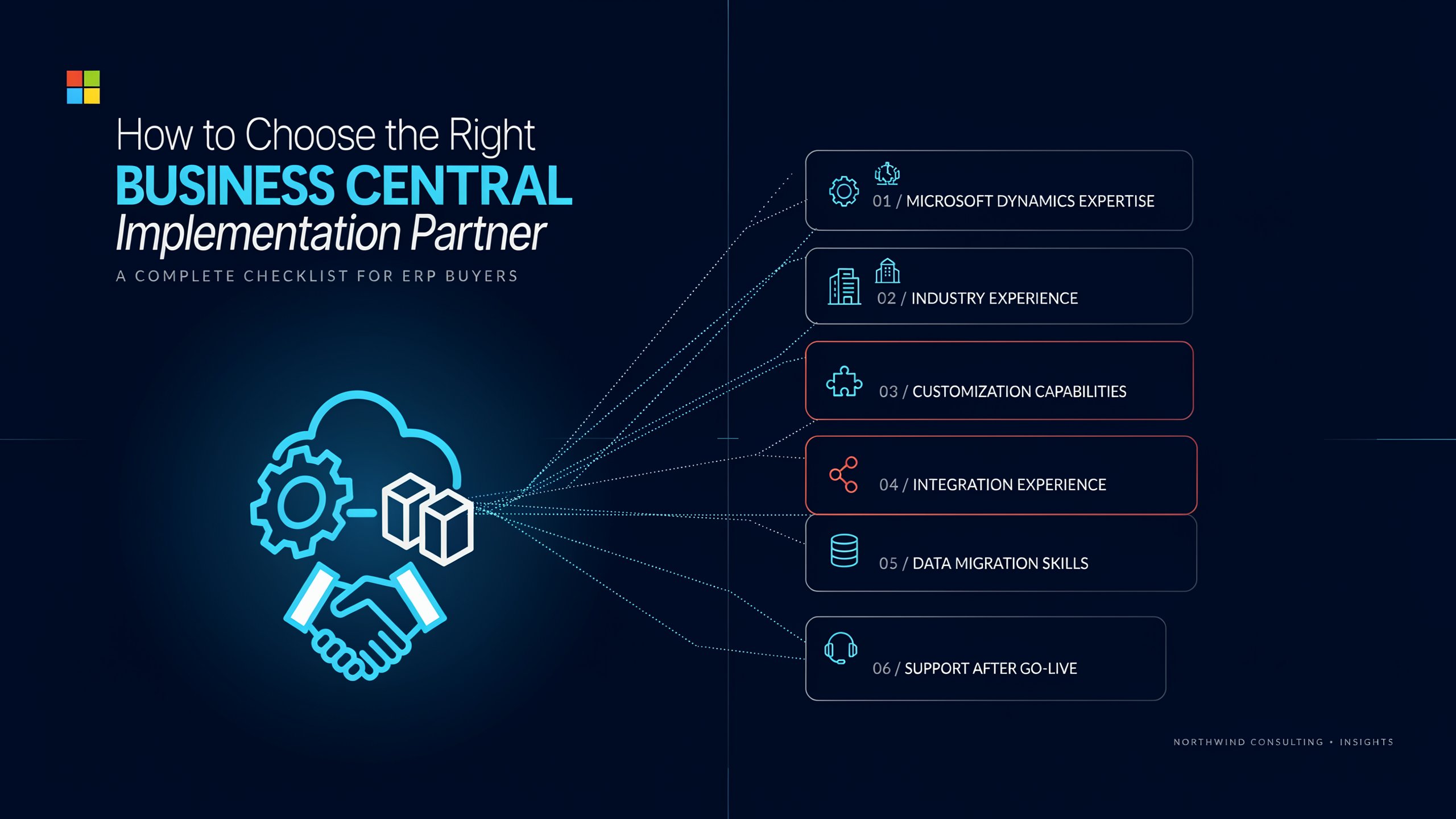
Many companies provide technology services that relate to Microsoft. Yet businesses must judge partners by the needs of their ERP project.
Microsoft Dynamics Expertise
First, examine the company’s experience with Microsoft Dynamics solutions and Business Central. A partner must understand the Microsoft Dynamics platform and the applications built on it.
Industry Experience
Industry knowledge can be very useful. A manufacturing company needs more features than a retail distribution, professional services, or healthcare organization.
Customization Capabilities
Every business follows its workflows. The implementation partner must customize Business Central whenever standard features are insufficient.
Integration Experience
Business Central often has to link to CRM platforms, payment systems, e-commerce platforms, reporting tools, or other applications. Integration experience is therefore a factor when choosing a partner.
Data Migration Skills
Moving financial, customer, product, supplier, and store data into a new ERP system demands careful planning. The partner must have a data migration process.
Support After Go-Live
Implementation is not the end of an ERP project. Employees might need assistance after launch. The system may need improvements as time passes. Therefore, businesses must also verify the partner’s support and maintenance capabilities.
Top Microsoft Dynamics 365 Business Central Implementation Partners
1. Aegis Softtech
Aegis Softtech is a technology services company that specialises in enterprise software solutions and Microsoft technology solutions.
For companies looking at Microsoft Dynamics 365 Business implementation partners, Aegis Softtech can be considered for execution, changes, unification, and support services.
A Business Central project often involves stages. These may include understanding business requirements, configuring the ERP environment, moving existing data, developing required custom features, and connecting Business Central with applications.
Aegis Softech’s broader enterprise technology experience can be useful for businesses that need more than an ERP setup. Companies with existing software systems may also require integration between Business Central and their current applications.
Key areas to consider include:
- Business Central implementation
- ERP customization
- Business process configuration
- Data migration
- Application integration
- Custom development
- Technical help
Adequate consideration is given to scalability. As businesses scale up, their ERP needs become different. The right approach to implementation should therefore be able to adjust to the complexity of workflows, users, and reporting.
Aegis Softtech should be contacted to discuss Business Central requirements considering the industry process, the scope of the project, the expected time of completion and the type of support desired before the start of an implementation.
2. Nex Softsys
Nex Softsys is another Microsoft technology and ERP implementation company that firms should consider hiring.
Business Central implementation can be both technical and business-related. Companies need to decide on the business processes that can be carried out through the features provided in Business Central and which processes need to be customized.
Nex Softsys should be considered for projects involving ERP implementation, customization, and integration.
A Business Central project typically requires the implementation team to work with different departments. The finance department may deal with accounting and reporting, while the sales department may work with customers and orders. Other processes may involve inventory, purchasing, warehouse, and the supply chain.
An implementation partner should bring these processes and departments together and help the business achieve end-to-end processes.
Customers should review Nex Softsys’ experience with their Business Central requirements. Migration and integration of data and systems, and customization and training, should be part of the services provided by Nex Softsys during and after the implementation.
Areas of evaluation include:
- Business requirements analysis
- Customization of Business Central
- Data and system integration
- Workflow automation
- Testing and Deployment
- Technical support
The right partner can bring the experience required for the implementation of Business Central for a firm, and give it the required support for growth.
3. Aegis Infoways
Aegis Infoways offers software and technology services to businesses that want to become digital.
Businesses evaluating Microsoft Dynamics 365 Business Central implementation partners can include Aegis Infoways in their selection of technology providers.
Implementing Business Central may change a business’s existing processes. For example, when a business migrates to an ERP from several disconnected applications, it may review and analyze its processes for purchasing and selling, as well as the management of inventory and finance.
An implementation partner can assist in mapping the business processes and workflows before configuration.
A project may include the following:
- Configuration of the ERP system
- Customization
- Data migration
- Integration
- User Acceptance Testing
- Deployment
- Support
- Other activities.
Business Central can connect with other applications and encourage a unified technology environment for businesses that have multiple disconnected applications.
Aegis Infoways should be considered by businesses in their shortlist for a Microsoft technology and ERP partner. However, businesses should assess Aegis Infoways against the requirements for their project, including the expected modules of Business Central, their industry, and the technological and support requirements.
4. Technoligent
Technoligent is a company that provides software and technology services and develops business technology solutions.
For companies looking for Microsoft Dynamics 365 Business Central implementation partners, Technoligent is an option to consider.
There are different levels of complexity with Business Central projects. A smaller business may want a simple solution with standard business processes. A larger business may want to use standard business processes and also implement multiple integrations, workflows, data migrations, and reports, as well as integrations with other business applications.
Experience with development and technology is important when considering a partner.
Technoligent can be considered for companies that want technology implementation and development services. Companies should discuss their Business Central needs in detail before making a decision.
Some areas that companies can evaluate when considering a Business Central partner include:
- Customizing and configuring Business Central
- Developing and integrating other business applications
- Data migrations
- Testing
- Deployment
- Maintenance and support
The goal of implementing Business Central is not to just implement the software. The focus should be to help employees use the software to perform everyday business processes in the organization, and to support the core business processes of the organization.
Benefits of Working With an Experienced Business Central Partner
- More organized Business Central implementation
- Lower risk of costly implementation errors
- Better understanding of business processes and ERP requirements
- Easier data migration from existing systems
- Smooth integration with other business applications
- Proper customization based on specific business needs
- Better employee training and system adoption
- Improved workflow automation and process efficiency
- Better Access to business data
- Ongoing technical help, after implementation
- Easier system upgrades and future improvements
- Scalable solutions that can support business growth
What Is the Business Central Implementation Process?
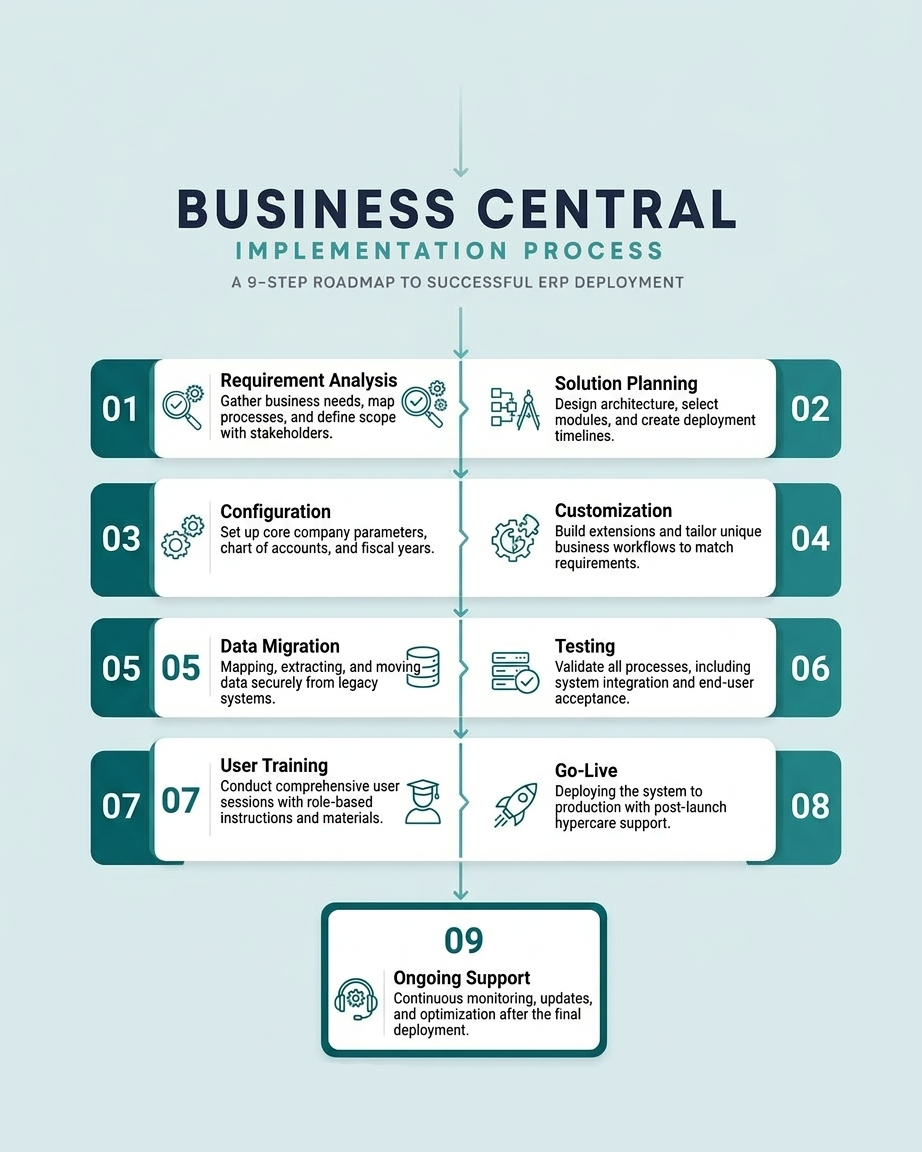
Business Central Implementation Process
Although every project is different, a Business Central implementation generally follows stages.
1. Requirement Analysis
The implementation team studies the company’s existing processes. Identifies business requirements.
2. Solution Planning
The team creates an implementation plan covering modules, workflows, integrations, customization, migration, and deployment.
3. Configuration
Business Central is configured according to the approved solution design.
4. Customization
Required custom features and workflows are developed.
5. Data Migration
Relevant data from existing systems is transferred.
6. Testing
The solution is tested against business scenarios to identify errors.
7. User Training
Employees are trained to work with Business Central and understand workflows.
8. Go-Live
The completed solution is deployed for business use.
9. Ongoing Support
The implementation partner can provide support. Help the company improve the system as its needs change.
Final Thoughts
Finding the right Microsoft Dynamics 365 Business Central implementation partners is a decision that organizations make once they decide to embark on an ERP transformation journey. It’s necessary to find partners that possess both the required technical know-how and the understanding of your business processes.
While evaluating your partner options, you may wish to review Aegis Softtech, Nex Softsys, Aegis Infoways, and Technologist. Before coming to a decision, review their experience and process. The extent of customization and integration they are willing to do, pricing, timelines, and post-deployment support.
The best partner is the one that can help an organization align Business Central with its business goals. Additionally, the partner should be able to provide support and services for Business Central over the term.